
The first solution
Low voltage electrical photovoltaic power generation overall solution (380V/220V distributed photovoltaic)
Applicable scenarios: Household rooftop photovoltaics, distributed photovoltaics on industrial and commercial plant roofs, AC side 400V low-voltage grid connection (generally ≤ 400kW multi-point low-voltage grid connection, exceeding capacity evaluated according to local power supply company requirements), following standards such as GB/T 19964, GB/T 16895.32, NB/T 32014.
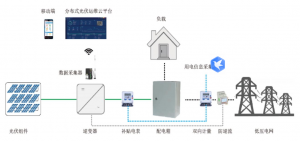
The overall architecture is divided into DC side (photovoltaic array) → inverter AC side → low-voltage grid connected distribution system → user load/public network, fully covering protection, distribution, metering, lightning protection, monitoring, and grid connection safety.
Topology diagram of low-voltage photovoltaic system
1、 Overall System Architecture
1) DC side system (from photovoltaic modules to inverters)
Photovoltaic modules → Photovoltaic dedicated DC cables → Intelligent photovoltaic combiner box → DC circuit breaker/DC isolation switch → Inverter DC input terminal
Key points of core low-voltage DC electrical system:
It is strictly prohibited to replace DC circuit breakers with AC switches; There is a continuous DC arc in the DC circuit, and DC1000V/DC1500V photovoltaic dedicated DC components must be selected.
Standard configuration of combiner box: string fuse, anti reverse diode, DC SPD surge, current monitoring; Large scale projects are equipped with AFCI DC arc fault protection (to prevent roof DC cables from catching fire).
Cable: PV1-F photovoltaic dedicated cable, laid with sun protection and anti rolling measures, with positive and negative poles separated for wiring.
2) Communication side system (inverter → grid cabinet → grid/load)
Inverter AC output → Inverter AC output switch → Low voltage photovoltaic grid connected cabinet (grid connected box) → User low-voltage busbar/public grid
Mainstream operating mode:
Self use and surplus electricity connected to the internet (preferred for industrial and commercial use)
Full internet access
Spontaneous self use, anti backflow (electricity is not allowed to be connected to the grid, some factory areas require it)
2、 Core low-voltage complete equipment and component solution
1. Photovoltaic intelligent combiner box (DC side)
Household small system: no combiner box, components are directly connected to micro inverters/string inverters
Industrial and commercial multi string: 4/8/12/16 intelligent combiner box
Configuration List:
DC fuse, DC isolation switch, DC lightning arrester (level II SPD), string current acquisition module, temperature and humidity monitoring, alarm output.
2. Inverter AC output protection
AC outlet configuration for each string inverter:
Communication molded case/miniature circuit breaker+residual current protection (RCD)
Function: Internal faults and AC leakage isolation of the inverter to prevent the entire system from being affected by a single inverter failure.
3. Low voltage photovoltaic grid connected cabinet (core complete equipment, key to grid connection acceptance)
Cabinet: Outdoor stainless steel SMC box/Indoor GGD/MNS low-voltage cabinet
Standard configuration:
Grid connected circuit breaker (4P): equipped with overcurrent and short-circuit protection, capable of accepting trip signals from anti islanding devices
Isolation knife switch (obvious disconnection point, safe maintenance)
Anti islanding protection device (mandatory requirement for power grid, islanding action ≤ 2s)
Communication level II surge protector SPD
Bidirectional intelligent energy meter (trade settlement measurement)
Temperature and humidity controller, heater (anti condensation)
Secondary control circuit, terminals, grounding copper bars
optional extension
Anti backflow controller (restricts reverse power transmission to the grid)
Power quality monitoring module (harmonic and three-phase imbalance monitoring)
Remote communication module (Modbus/4G cloud)
Key point: The grid connection point must be set up with obvious and visible disconnection points, and dual power warning signs must be posted on the cabinet.
3、 Complete protection scheme (low-voltage electrical safety core)
1) DC side protection
Series overcurrent protection: DC fuse
Busbar short circuit: DC circuit breaker
Inductive lightning protection: DC SPD
Advanced configuration: AFCI DC arc fault protection (recommended for industrial and commercial roofs)
Equipotential grounding: The metal casing of photovoltaic brackets and combiner boxes should be reliably grounded
2) Low voltage protection on the communication side
Anti islanding protection (mandatory)
Quickly disconnect the grid connection switch after the power grid loses power, prevent photovoltaic power from reversing power to the power outage line, and ensure the safety of power maintenance personnel; The string inverter comes with an islanding algorithm, and an independent external anti islanding device is added to the grid connection point of high-capacity projects.
Overvoltage, undervoltage, overclocking, and low-frequency protection (dual redundancy of inverter and grid protection)
Short circuit and overload protection: grid connected circuit breaker
Leakage protection: AC/A-type residual current protector to prevent personal electric shock
Surge protection: AC SPD configuration for inverter AC terminal and grid connected cabinet
Anti backflow protection (configured as needed)
When the owner does not allow surplus electricity to be connected to the grid, install anti backflow controllers to monitor the grid current in real time. Once reverse power occurs, reduce the inverter output until the output is blocked.
3) Lightning protection and grounding system
Graded lightning protection: Level I optional for photovoltaic array area, DC level II for combiner box, and AC level II SPD for grid connected cabinet
Grounding requirements:
Grounding resistance of<100kW power station ≤ 10 Ω; ≥100kW ≤4Ω;
Component brackets, all electrical cabinets, and inverter enclosures are uniformly connected to the photovoltaic main grounding grid; Grounding main line ≥ 50mm ² copper conductor.
4、 Measurement scheme (meeting the grid connection acceptance of the power supply company)
Self use and surplus electricity connected to the internet
Install bidirectional smart meters at the property boundary point to measure forward purchase and reverse sale of electricity;
Optional installation of an inverter side power meter for internal power generation statistics.
Full internet access
A unidirectional meter measures the total amount of photovoltaic power generated.
Measurement specification: The transformer is selected as 0.5S level, with independent wiring for the secondary circuit, in compliance with DL/T448.
5、 Monitoring and intelligent operation and maintenance of low-voltage electrical solutions
Basic plan
Inverter local display screen+mobile app, view power generation and fault alarms.
Centralized monitoring scheme for industry and commerce
Collect electrical data (voltage, current, power, switch status) from inverters and grid connected cabinets through the gateway, and upload it to the photovoltaic cloud platform;
Realizable functions: remote alarm, power generation statistics, fault location, power quality analysis;
Large scale parks can be connected to the existing low-voltage distribution monitoring system (SCADA) in the factory area.
6、 Simplified low-voltage solution for household photovoltaic (≤ 10kW single-phase 220V)
Photovoltaic module → string inverter (single-phase) → AC circuit breaker → photovoltaic grid connection box (4P grid connected air switch SPD、 Bidirectional electricity meter → User’s household distribution box
Key point: Single phase access capacity is generally limited to within 8kW in various regions. If it exceeds this limit, it is recommended to switch to three-phase 380V access.
7、 Industrial and commercial roof (30-400kW three-phase 380V typical scheme topology)
Photovoltaic array → Multi channel intelligent combiner box → DC cable → Multiple string inverters → AC outlet switches for each inverter → Collection of low-voltage grid connected busbars → Photovoltaic grid connected main cabinet (grid connected switch+anti islanding+bidirectional metering) → 0.4kV low-voltage busbar in the factory area.
8、 Common Design Risks and Low Voltage Selection Red Line
❌ Prohibit the use of AC circuit breakers for photovoltaic DC circuits;
❌ Cannot omit the isolation fracture and anti islanding device of the grid connection point;
❌ SPD failure alarm without matching, lightning protection is easily lost in thunderstorm weather;
❌ Multiple scattered grounding points have not formed a unified equipotential;
❌ The circuit breaker does not perform selective coordination, resulting in a fault that triggers a trip beyond the level;
✅ Select anti-corrosion C5 grade components for high salt spray coastal areas, with outdoor cabinets IP54 or above;
✅ Low voltage components are selected for capacity reduction in high and low temperature, high-altitude areas.
9、 Optional upgrade plan for supporting facilities (extension of integrated light storage)
If energy storage is added in the future: adding a low-voltage energy storage converter PCS+energy storage grid connected cabinet to achieve joint operation of photovoltaic and energy storage, peak valley arbitrage, backup power supply, and peak shaving and valley filling; Bidirectional power coordination control for supporting grid connection points.